
Why focus on roads?
A well-performing road network is the lifeblood of socio-economic development. It is at the heart of economic well being of the business and manufacturing sector but at the same time is essential to municipal service delivery through providing access to essential services such as health and education. According to SANRAL, the asset value of roads in South Africa is in the order of R2 trillion. This vital asset needs protection, regular maintenance and expansion for South Africa to achieve the vision of the National Development Plan. There are a number of challenges with roads in South Africa though. These include:
- the current poor state of the secondary and tertiary road network (according to the SAICE 2017 Infrastructure Report Card);
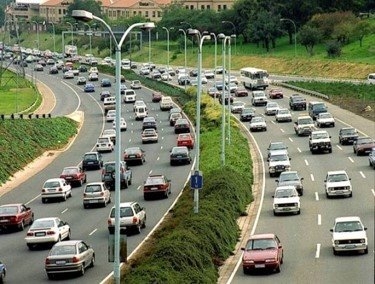
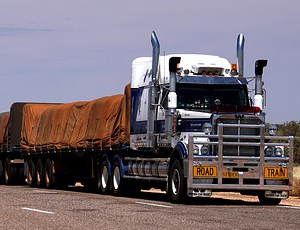
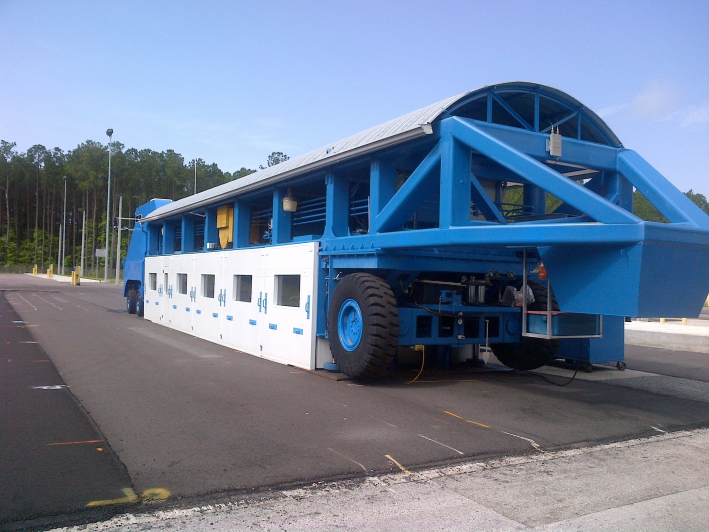
- the ever-increasing loading of the road system (the National Road 3 has, in the last three years, carried the same loading as in the previous 20 years);
- the impacts of climate change on the performance of roads and their longevity;
- the impact of urbanisation on the transport system (by 2030, 70% of South Africans will live in major urban areas);
- the increasing scarcity of good quality road building materials;
- the emphasis on the use of marginal and waste materials in road construction;
- the shortage of qualified road pavement engineers in South Africa, and
- lack of sufficient funding to maintain and expand the road network.
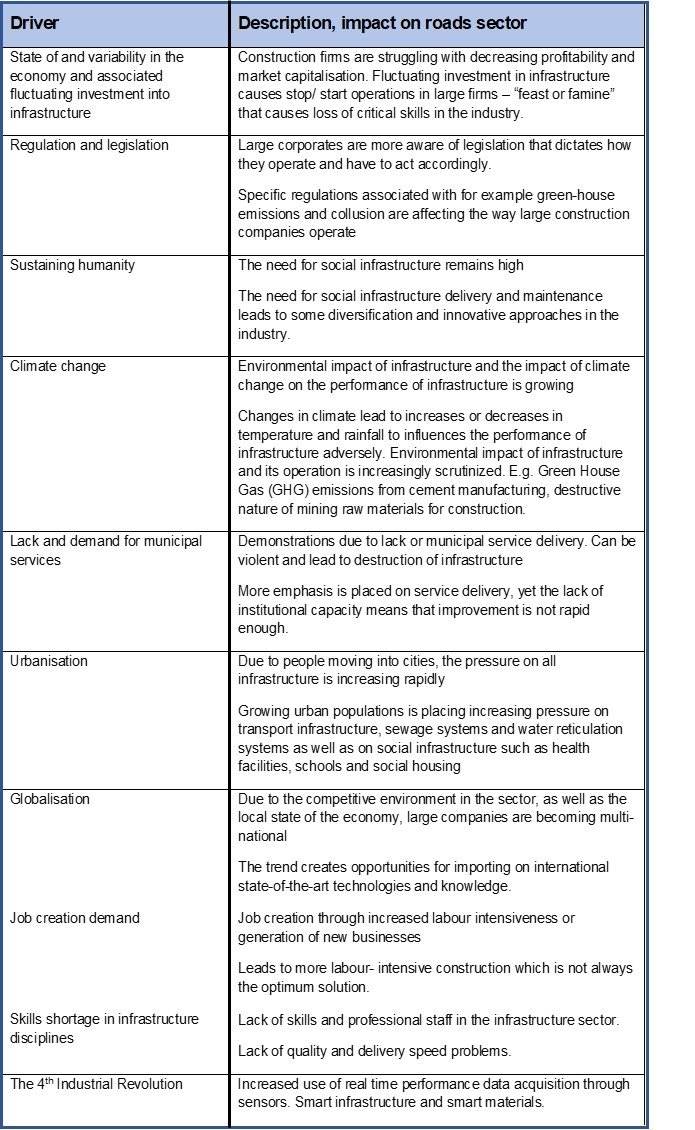
To address these challenges South Africa will have to find appropriate solutions for materials and road design methods to ensure optimal performance of roads at the lowest possible cost. More detail on the challenges and potential responses are given in the table below.

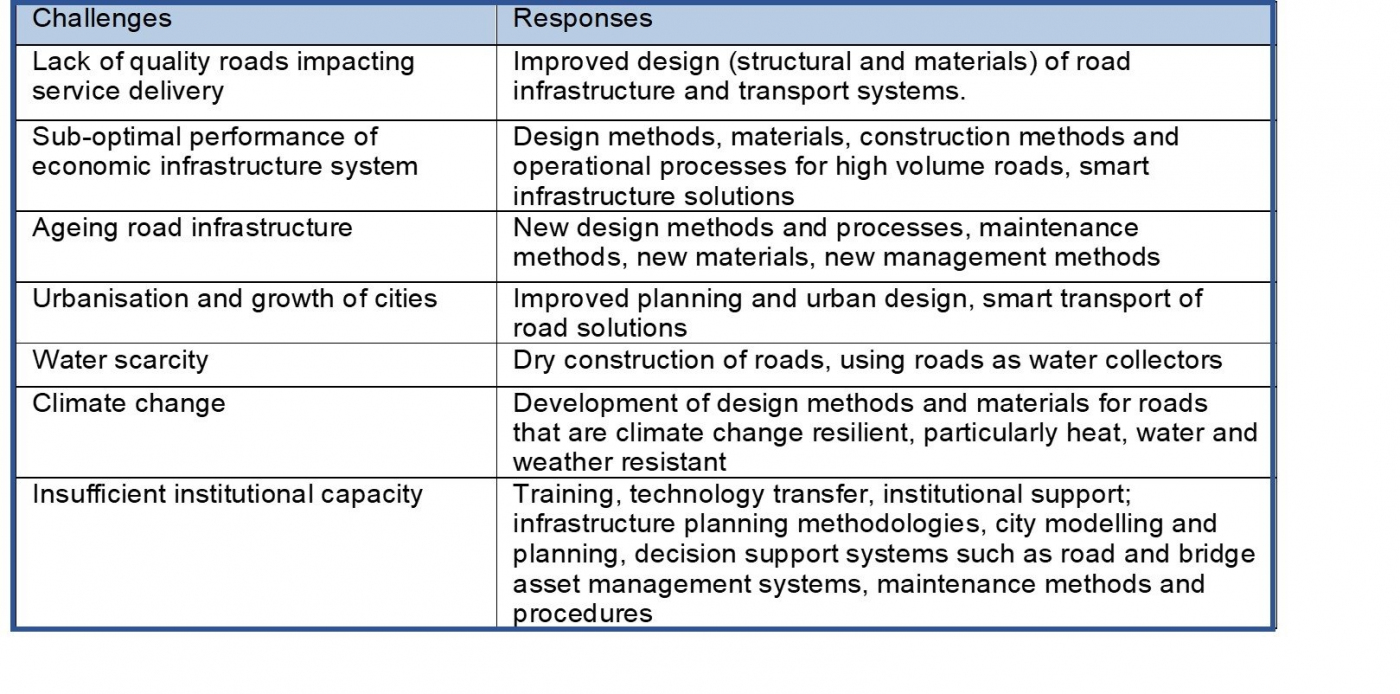
There are a number of drivers that impact road in South Africa. These can be seen in the table below.
The 4th industrial revolution (Industry 4.0)
In his landmark book on the Fourth Industrial Revolution published in 2017, Klaus Schwab, Founder and Executive Chairman of World Economic Forum, comments on the new drivers that will and are influencing industry. These include:
Physical drivers:
- Autonomous vehicles
- 3D printing (additive manufacturing)
- Advanced robotics
- New materials
Digital drivers:
- Internet of Things (IOT)
- Sensors
- Blockchain (cryptographically secure ledgers)
- Technology-enabled platforms (e.g. smartphone applications such as Uber)
Biological drivers:
- Genetic sequencing and engineering
- Synthetic biology (CRISPR/Cas9)
According to Schwab, there are a number of tipping points that could occur by 2025. Some of these include:
- 1 trillion sensors connected to the internet;
- The first 3D-printed car in production;
- 90% of the population using smartphones;
- 90% of the population with regular access to the internet;
- Driverless cars equalling 10% of all cars on US roads;
- Globally more trips/ journeys via car sharing than in private cars;
- The first city with more than 50,000 people and no traffic lights;
Impact:
The impact of the 4th Industrial Revolution on infrastructure, including roads and transport systems, will by widespread. These include:
- Economic growth leading to high loads on infrastructure due to increased transport
- Ageing of the population which changes the demographic of travellers
- Employment shifts away from manual labour to more sophisticated job types
- Labour substitution – new techs create fewer new jobs than before (growth in high end jobs, decrease in middle income jobs)
- Increased inequality and gender gap
- Potential marginalisation of developing countries
- Expectation of users of infrastructure of the quality of the service will shift
- Sensors and data enhancement of infrastructure operations can lead to improved performance
- New partnerships required to deliver higher quality services
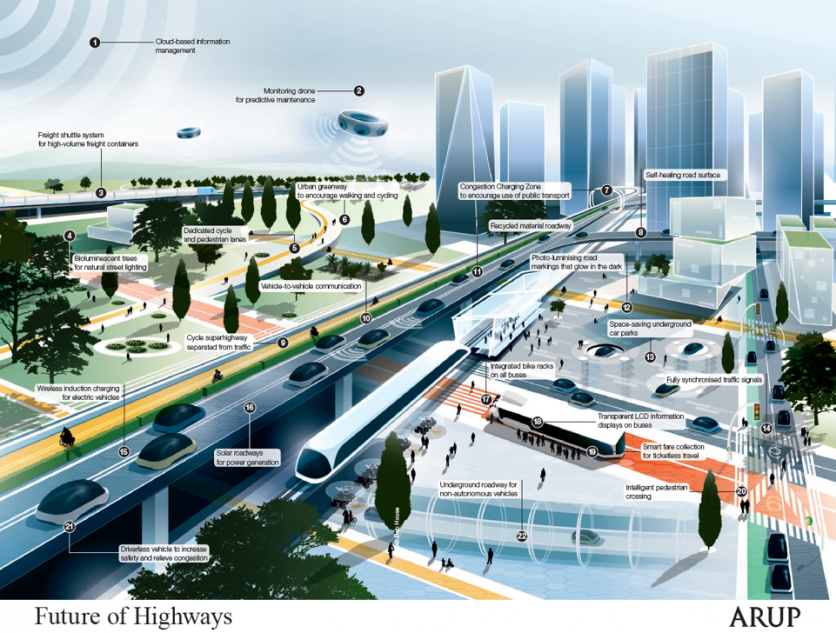
- Smart technologies such as sensors, optics, embedded processors and solutions such as mobility on demand could change the way infrastructure operates and performs
Smart Roads
A Research Agenda for Smart Infrastructure in South Africa was published by Rust and Debba (2016). Smart infrastructure is defined in many ways. The Royal Academy of Engineering (Royal Academy of Engineering 2012, Smart infrastructure: the future) defines it as “a system that uses a feedback loop of data as evidence for informed decision-making. The system can monitor, measure, analyse, communicate and act, based on information captured. Different levels of smart systems exist. A smart infrastructure system may:
- collect usage and performance data to help future designers to produce the next, more efficient version;
- collect data, process them and present information to help a human operator to take decisions (for example, traffic systems that detect congestion and inform drivers); and
- use collected data to take action without human intervention.”
However, smart infrastructure can be defined broader to include for example smart materials and smart processes.
Smart materials would include for example:
- Self-healing materials;
- Road materials that are less brittle at cold temperatures (to prevent cracking|) yet stiffer at high temperatures (to prevent deformation);
- Road materials that become stiffer when under loading;
- Nano-modified materials (such as emulsions) that improve the structural strength of marginal materials when they are treated.
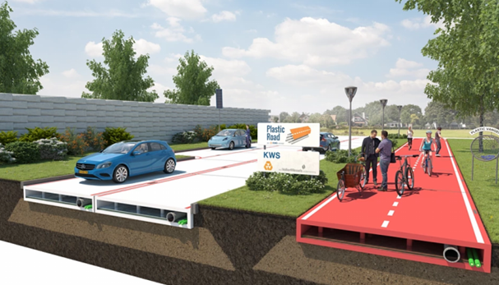
Smart processes could include the process of off-site manufacturing of road elements and on-site assembly.


Pavement Engineering Research Consultancy (PERC) (Pty) Ltd
Enterprise No: 2019/050420/07
© 2019 perc.co.za
Pretoria
RSA